15 Newborn Photography Tips Every Parent Should Know (2026)

15 Newborn Photography Tips Every Parent Should Know (2026)
Those first days with your newborn pass in a blur of feedings, sleepy snuggles, and tiny yawns you'll never want to forget. Whether you're hiring a professional photographer or picking up your own camera, knowing the right techniques can mean the difference between blurry snapshots and heirloom-quality images you'll treasure for decades.
This guide covers everything — from timing the shoot to editing the final images — so you walk away with photographs that actually capture how impossibly small and perfect your baby was on day one.
Section 1: Preparation
Great newborn photos start before the camera even comes out. How you prepare the environment, the baby, and yourself sets the stage for everything that follows.
Tip 1: Schedule the Shoot Within the First 5–14 Days
Newborns are most cooperative — and most photogenic — during the first two weeks of life. In this window, babies sleep deeply, curl naturally into womb-like poses, and still have that fresh, soft look that disappears quickly. After day 14, babies become more alert and harder to settle, and the soft skin texture begins to change. If you're booking a professional, lock in your session date before the baby arrives and confirm once you've delivered. For DIY shoots at home, aim for day 5–10 when feeding routines start to settle but the newborn "curl" hasn't faded.
Tip 2: Warm the Room to at Least 75–80°F
A cold baby is an unhappy baby — and an awake one. Newborns are used to the warmth of the womb, so keeping the room noticeably warmer than your usual comfort level helps them stay sleepy and relaxed throughout the session. Crank the heat 30–45 minutes before you begin and have a space heater nearby if needed. Keep the baby undressed only when actively shooting a particular pose, and have a warm blanket on standby for in-between setups. Comfortable, toasty babies = dreamy, peaceful photos. Don't skip this step — it's one of the biggest factors in how smoothly a session goes.
Tip 3: Feed Right Before the Session
A full belly is a sleeping baby's best friend. Time feedings so your newborn finishes eating about 20–30 minutes before the shoot begins — enough time for any gas to settle, but not so long that hunger creeps back. If you're breastfeeding, nurse on demand during the session whenever the baby stirs. For formula-fed babies, have a bottle ready to top them off between pose changes. Some photographers schedule sessions right after a feed as part of their standard workflow, and it's a trick worth stealing for any DIY setup. A hungry newborn will fight every pose and keep you from getting any usable shots.
Tip 4: Prepare Your Props and Backdrop in Advance
Scrambling for props mid-session wakes the baby and breaks your rhythm. Gather everything beforehand: wraps, blankets, headbands, baskets, wooden crates, or bowls you plan to use. Lay them out in order of the poses you want to capture so transitions are smooth and quiet. Stick to soft, neutral-toned fabrics for wraps — cream, beige, dusty rose, sage — because busy patterns distract from your baby's face. If you're using any hard props like baskets or bowls, line them with a thick, padded insert and always have a spotter. Set your backdrop (a simple white wall or seamless paper works perfectly) before the baby even enters the room.
Section 2: Lighting
Lighting is the single most powerful tool in photography, and with newborns, getting it right is especially important. Harsh light emphasizes texture and creates unflattering shadows; beautiful light makes skin glow and wraps around tiny features perfectly.
Tip 5: Use Natural Window Light Whenever Possible
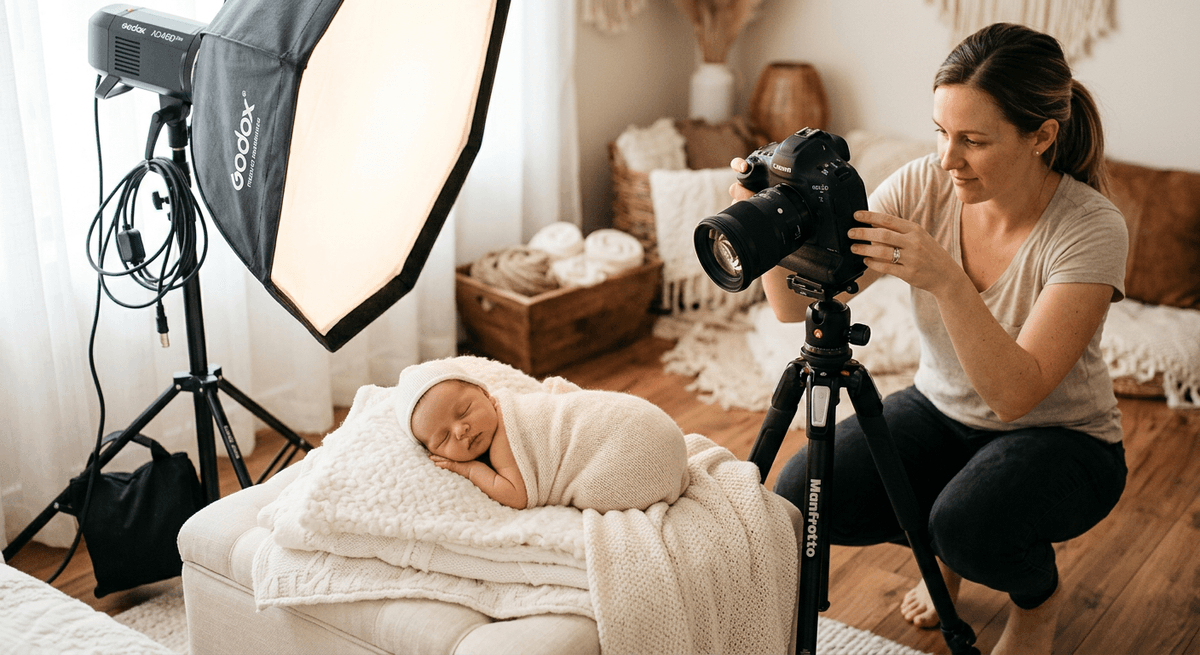
The most flattering light for newborn photography is soft, indirect natural light from a large window. Position your shooting area within 3–6 feet of a window — ideally north- or east-facing to avoid direct sunlight. Place the baby perpendicular to the window so light falls across their face rather than directly on or away from it. Overcast days are actually ideal: clouds act as a giant natural diffuser, producing even, shadow-free light that's incredibly forgiving. Avoid shooting in the middle of the day when window light is harshest. Early morning or late afternoon windows offer the warmest, most beautiful tones for baby skin.
Tip 6: Avoid Direct Flash at All Costs
Camera flash — especially the built-in pop-up flash — is your worst enemy in newborn photography. It creates harsh, flat light, red-eye, and can startle your sleeping baby awake. If you need artificial light, use an off-camera flash bounced off the ceiling or a wall, or invest in a continuous LED panel with a large softbox diffuser. Set the light at a 45-degree angle to the baby and position it slightly above their eye level to mimic natural window light. Continuous lights have the added advantage of letting you see exactly how the light falls before you shoot, removing the guesswork entirely.
Tip 7: Use Reflectors to Fill Shadows
Even beautiful window light can create deep shadows on the opposite side of your baby's face. A simple 5-in-1 reflector — or even a large piece of white foam board — placed on the shadow side bounces light back and fills in those dark areas without adding another light source. Position the reflector close enough to make a visible difference (experiment with 1–3 feet away) but out of frame. The silver side gives a brighter, cooler fill; the white side is softer and more neutral. Reflectors are inexpensive, lightweight, and one of the highest-impact tools for improving newborn photos without spending hundreds on gear.
Section 3: Posing & Safety
Newborn posing looks effortless in professional photos, but it requires patience, practice, and an unwavering commitment to safety. Beautiful poses mean nothing if they put your baby at risk — always prioritize comfort and safety over aesthetics.
Tip 8: Never Force a Pose
If your baby resists a position — stiffens, cries, or repeatedly shifts out of it — move on. Forcing poses can cause discomfort and injury. The most iconic newborn poses (the "froggy," the "womb," the "taco") all require a deeply sleeping, relaxed baby who can be moved very slowly and gently into position. Take your time transitioning between poses: move one limb at a time, pause if the baby stirs, and let them resettle before continuing. Many professional photographers spend 2–4 hours on a single newborn session because they work entirely at the baby's pace. Patience is not optional — it's the technique.
Tip 9: Always Have a Spotter for Composite Poses
Some of the most impressive newborn images — a baby in a tiny basket, posed in a parent's hands, or balanced in a prop — are actually composites. The photographer takes multiple images with a spotter's hands supporting the baby, then merges them in editing to remove the hands from the final image. Never attempt elevated or balance-dependent poses without a trusted adult standing by with hands close to (but not touching) the baby. This isn't overcaution — it's standard professional practice. If you're shooting solo at home, skip freestanding prop poses entirely and opt for flat or low-profile setups where the baby is safely supported on a surface.
Tip 10: Wrap Techniques for Calm and Comfort
Wrapping is the newborn photographer's greatest tool for achieving calm, cooperative babies. A good wrap mimics the snug sensation of the womb, which soothes babies and keeps them in position. Use a stretchy jersey-knit wrap for beginners — it's forgiving and easy to work with. Start by swaddling the baby tightly with arms in, tucking any loose fabric securely. For posed wraps (where you see the wrap as part of the image), layer complementary colors and textures. Practice the basic swaddle dozens of times before your session. A well-wrapped baby who feels secure will sleep through nearly any pose change, making your whole session dramatically easier.
Section 4: Camera Settings
You don't need a professional camera to capture beautiful newborn photos, but understanding your settings — whatever camera you're using — will dramatically improve your results.
Tip 11: Shoot in Aperture Priority Mode (or Manual)
For still, sleeping babies, Aperture Priority (Av or A mode) gives you creative control over depth of field while letting the camera handle exposure. Choose a wide aperture (f/1.8–f/2.8) to blur the background and draw attention to your baby's features. For full-body shots where you want everything in focus, step back to f/4–f/5.6. If you're shooting in consistent window light, transitioning to full Manual (M) mode gives you the most predictable, repeatable results — set your ISO to the lowest clean value your camera allows in that light (typically ISO 200–800), dial in your aperture, and adjust shutter speed until the exposure is right. Aim for at least 1/125s to avoid motion blur.
Tip 12: Shoot RAW Format for Maximum Editing Flexibility
If your camera supports RAW files, use them. RAW files capture significantly more image data than JPEGs, giving you far greater latitude when editing exposure, white balance, and color in post-production. Newborn photos often need subtle color corrections — warming up cool window light, neutralizing green casts from indoor walls, correcting slightly over- or under-exposed images — and RAW files handle these adjustments without degrading quality. The files are larger, so invest in a fast, high-capacity memory card. If you're shooting on a smartphone, use an app like Halide (iOS) or Adobe Lightroom Mobile (Android/iOS) that supports DNG (RAW) capture for maximum editing control.
Tip 13: Focus on the Eyes (Even When They're Closed)
In newborn photography, where do you focus? The eyes — even closed ones. When a baby's eyes are shut, focus on the eyelashes or the closed eyelid. This keeps the sharpest part of the image on the face rather than the forehead or cheeks, which is what draws the viewer's eye first. Use single-point autofocus and position your focus point directly over the eye before shooting. If you're shooting at a very wide aperture (f/1.8), even tiny focusing errors will show — lock focus carefully, then reframe if needed. For profile shots or partial face compositions, focus on the eyelashes on the near side of the face.
Section 5: Editing
Even the best-composed photos benefit from thoughtful editing. Newborn photos in particular have specific tonal and color characteristics that editing can dramatically enhance — or destroy if overdone.
Tip 14: Keep Skin Tones Warm and Natural
Newborn skin can look red, blotchy, or uneven straight out of camera — that's completely normal and part of being brand new. In editing, resist the urge to over-smooth or blur skin texture. Instead, focus on correcting white balance to bring warmth to the tones (slightly warm is more flattering than cool), then gently reduce redness using the HSL panel in Lightroom by pulling down saturation in the Red and Orange channels. A subtle vignette draws the eye toward the baby and away from the edges of the frame. Avoid heavy presets that crush blacks or over-saturate colors — the goal is to look like a beautiful moment, not a heavily filtered Instagram post.
Tip 15: Use AI Photo Enhancement to Elevate Your Best Shots
Once you've selected your favorite images from the session, AI-powered enhancement tools can take them to the next level — boosting sharpness, improving exposure balance, and even suggesting artistic enhancements you might not have considered. Tools like BabyGenic AI are purpose-built for baby and family photos, using trained models that understand what makes newborn imagery beautiful. Rather than applying generic edits, BabyGenic AI recognizes faces, skin tones, and the emotional weight of these milestone moments to deliver enhancements that feel intentional, not algorithmic. Upload your best shots after your basic Lightroom or Snapseed pass and let the AI refine them into something you'd actually want to print and frame.
Turn Your Photos Into Art with BabyGenic AI
You've captured the moments — now make them timeless. BabyGenic AI transforms your newborn photos into stunning, professionally enhanced images using AI trained specifically for baby and family photography. No design skills required. Upload your photo, choose your style, and download a print-ready masterpiece in minutes.
Frequently Asked Questions
When is the best time to do a newborn photo session?
The ideal window is between days 5 and 14 after birth. During this time, babies sleep deeply and curl naturally into posed positions. By the third week, babies become more alert and less cooperative for posed photography. If you missed the newborn window, don't worry — lifestyle and milestone sessions at 3, 6, and 12 months are beautiful alternatives.
Do I need a professional camera for good newborn photos?
Not necessarily. Modern smartphones (iPhone 15 Pro, Pixel 9, Samsung Galaxy S25) capture remarkable images in good light. The most important factors are lighting, timing, and patience — not gear. That said, a mirrorless or DSLR camera with a 50mm or 85mm prime lens gives you more creative control and better low-light performance. If you own a DSLR that's been sitting in a closet, dust it off — it will outperform any smartphone in challenging lighting conditions.
What props work best for newborn photography at home?
Simple is almost always better. A neutral-colored blanket or wrap, a wooden bowl or crate lined with a soft insert, and a white backdrop (a plain wall or seamless paper roll) are all you need to create professional-looking results. Avoid overly themed props, busy patterns, or anything that draws attention away from the baby. Your newborn is the subject — props should frame, not compete.
How do I keep my newborn asleep during a photo session?
Warmth is your biggest tool. Keep the room at 75–80°F, use a white noise machine at moderate volume (mimics womb sounds), and feed the baby right before shooting. Move slowly and deliberately when transitioning poses, giving the baby time to resettle between changes. If they wake, pause completely, soothe, and wait for deep sleep to return before continuing. Sessions often take 2–3 hours at a baby's pace — that's normal, not a failure.
Are composite poses safe for newborns?
Yes — when done correctly by a trained photographer with a dedicated spotter. Composite poses (where a spotter's hands are digitally removed in editing) allow for images that would be physically impossible without support. The danger comes from attempting these poses without proper spotting or rushing a baby into position. For DIY home sessions, stick to simple flat poses and avoid any setup where the baby isn't fully supported on a surface at all times.
How can I enhance my newborn photos after the shoot?
Start with basic edits in Lightroom, Snapseed, or your phone's native editor — adjust exposure, white balance, and do a light crop. From there, BabyGenic AI can take your best shots and apply intelligent enhancements tailored specifically to baby photography. The AI understands skin tones, soft lighting, and the emotional quality of newborn images, producing results that look hand-edited rather than filtered. It's the fastest way to turn a good photo into something frameable.
The Bottom Line
Newborn photography is equal parts technical skill and patient presence. Master the basics — warm room, good light, full belly, gentle timing — and you've solved 80% of the challenge before you even pick up a camera. The other 20% is practice, patience, and a willingness to follow your baby's lead rather than force a shot that isn't working.
Whether you're a first-time parent with a smartphone or a hobbyist photographer with a full kit, these 15 tips give you a professional-grade foundation for capturing the most fleeting, precious moments of your child's life.
And when the shoot is over? Let BabyGenic AI help you finish the job — turning your raw captures into polished, print-ready photos you'll be proud to show off for years to come.
👉 Get started with BabyGenic AI — it's free →
Written by the BabyGenic AI Team — experts in AI-powered baby and family photography enhancement.